FIND
Company context and prospect intelligence.
HOW IT WORKS
The same evidence thread moves from the first account signal to the client conversation, the work plan, and the proof that the observable state changed.
THE COMPLETE SCOUTz JOURNEY
The same source-aware evidence thread moves from account research to the work the MSP owns and the proof a supported condition changed.
Company context and prospect intelligence.
Bounded public Domain evidence.
Evidence, unknowns, and better questions.
The customer approves a defined deeper source.
Read-only Cloud evidence within stated coverage.
Findings, evidence, business context, and tools.
Fix guidance, ownership, sequence, and verification.
PSA, RMM, Microsoft, security, and delivery systems.
Rescan the condition the source can observe.
Generic work plan · MSP validates scope, change control, and rollback
DOMAIN → CONVERSATION → CLOUD
Before permission, public evidence creates relevance and questions. After permission, supported tenant evidence can replace selected assumptions. Neither stage guarantees a sale.
What can we observe? What does it support? What remains unknown?
Explain the unknown, the source needed, what will not be read, and who authorizes access.
What is configured? Who or what is affected? What should change, wait, or stay alone?
Consented, read-only configuration and metadata · no mail, files, or content
FINDING → WORK → VERIFY
The handoff is a feature. SCOUTz prepares the evidence and work context; the operational stack executes; SCOUTz returns only where a supported source can verify change.
Condition, source, evidence, boundary.
Questions and environment context.
Cautions, prerequisites, rollout, rollback.
Owner, sequence, effort, dependencies.
PSA, RMM, Microsoft, EDR, backup, SOC.
The MSP performs the authorized change.
Rescan or appropriate validation.
A broad permission grant deserves an owner, business purpose, and activity review before any change is recommended.
Generic application · illustrative evidence states · no customer data
Verification is limited to the source and condition actually checked
Lead → call → appointment → generic discovery → PDF → proposal → “just checking in”
Company → prospect intelligence → Domain evidence → conversation → consent → Cloud evidence → plan → decision
HOWEVER YOU FOUND THEM
SCOUTz prepares the company context, outside-in evidence, unknowns, and questions before the first conversation. Deeper evidence arrives only after the prospect authorizes it.
The workflow helps the MSP prepare, interpret, recommend, and verify. It does not automate the relationship, promise the decision, or replace the person accountable for the advice.
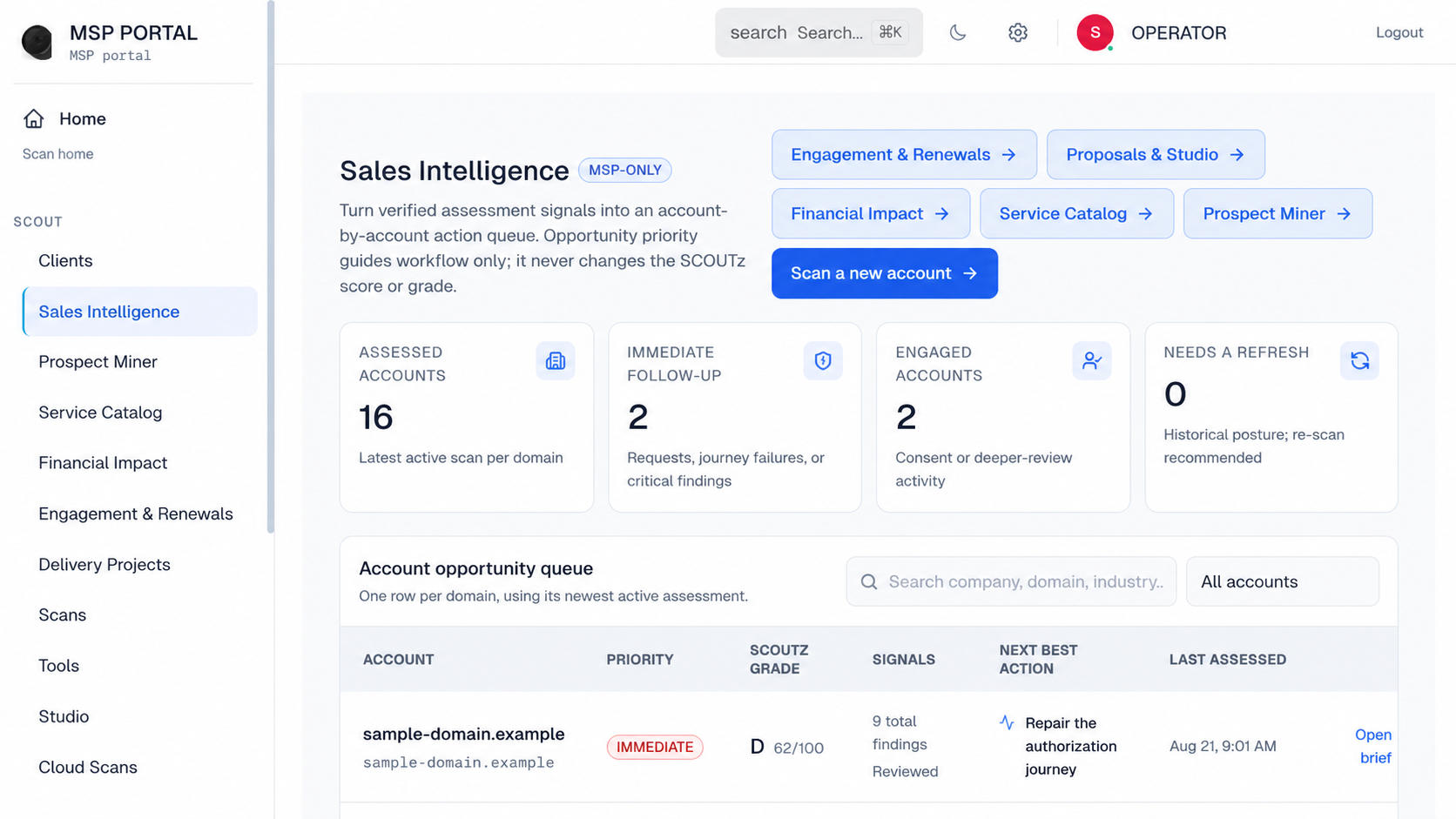
Build an account brief from SCOUTz-owned observations, public events, approved enrichment, and clearly labeled inference.
Run the domain review without customer access. Add Microsoft 365 only after customer approval and disclose every unavailable source.
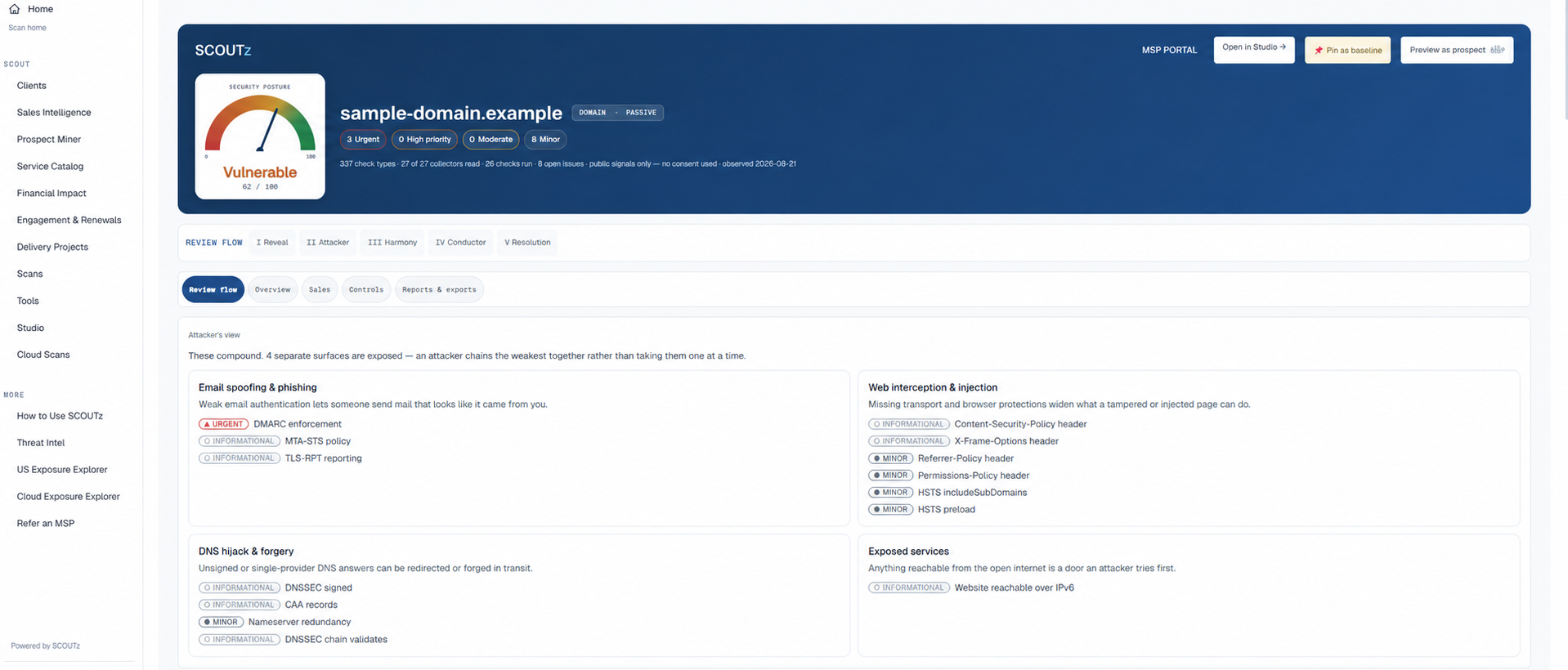
Review the evidence, attacker view, business context, 3AM questions, and the report appropriate for each audience.
Investigate the environment, use guidance and cautions, assign an owner, build the work plan, and deliver through the MSP’s process.
Rescan the observable controls, compare the new state with the baseline, preserve the proof, and bring it into the next client review.
Discover the condition. Understand the context. Review the available evidence. Recommend the outcome. Then the MSP selects the solution, vendor, service model, and commercial package.
SCOUTz prepares source-linked work for the MSP’s PSA, RMM, Microsoft administration, security, backup, or project system. Execution stays in the operational stack; SCOUTz returns only where supported evidence can verify the result.
Verification is limited to the source and condition actually checked
SCOUTz OPEN BETA
Bring a real MSP workflow and see how SCOUTz turns evidence into the next defensible action. The review runs without an agent or install and never changes configuration automatically.
SCOUTz prepares the conversation. The relationship and the sale stay yours.