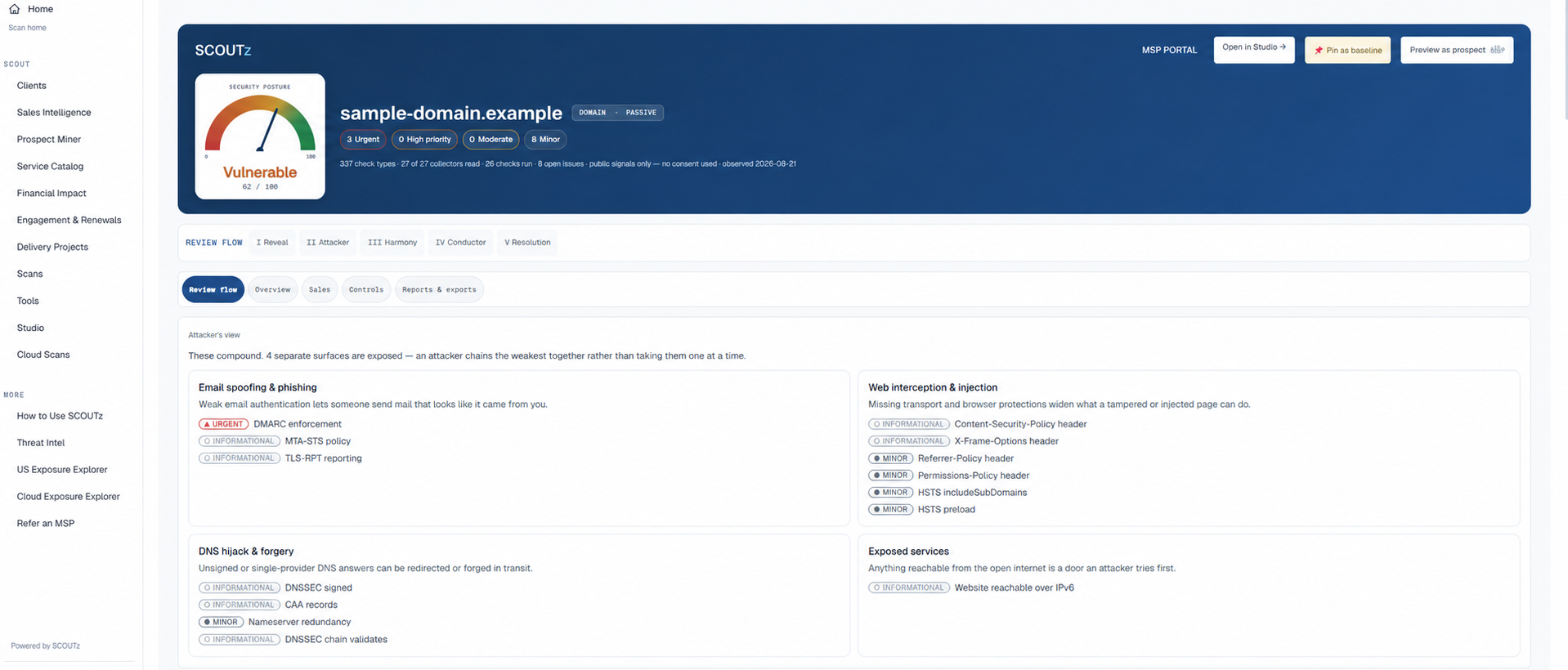
SCOUTz starts with supported observations instead of assuming an imported PSA, RMM, or security inventory is complete; it correlates those systems afterward and turns differences or unknowns into better questions.
We could have built SCOUTz around the data already sitting in the MSP stack. It would have been easier. Pull the PSA inventory, import the RMM devices, add the security-tool alerts, put a new score on top, and call the result intelligence.
That works right up until the company is not a client yet.
There may be no agent, tenant consent, ticket history, documentation, admin credential, or incumbent cooperation. More importantly, the things already recorded may not include the thing nobody knew to record. An imported inventory can be useful and still be incomplete.
What does independent discovery mean for an MSP?
It does not mean SCOUTz magically sees the entire environment from the outside. Public domain evidence has a narrow boundary, and we say that plainly. Independent discovery means the first observation comes from a disclosed source instead of beginning with the assumption that an existing inventory defines reality.
A PSA answers, “What did somebody record?” An RMM answers, “What do I manage?” A security product answers, “What can I see from my position?” Those are valuable answers. SCOUTz asks a different opening question: “What can we support from the sources available now, and what remains unknown?”
The order matters. Discover. Record the source and time. Normalize the evidence. Correlate it with the MSP's other systems. Compare what was observed with what was expected. Then turn the difference into a question before turning it into a finding.
That last part keeps the product honest. If public evidence suggests a backup vendor, the conclusion is not “backups are healthy.” If an enterprise application appears after authorization, its presence is not proof of unsafe use. The result may be a question about ownership, scope, activity, or business purpose.
Why is discovery most useful before the sale?
The seller needs help before the operational stack becomes powerful. Company context and public domain evidence can establish a responsible first layer. Unknowns show what to ask. The conversation can earn read-only authorization. Supported tenant evidence can then replace selected outside-in assumptions.
When the condition becomes work, the PSA, RMM, Microsoft console, EDR, backup platform, SOC, and project systems should do what they were built to do. SCOUTz should hand them a better input and return later where the source can verify the change.
We did not build our own discovery engine because other MSP tools are bad. We built it because their jobs begin from their own operating perspective. SCOUTz needed to begin one step earlier.
Evidence should start with discovery, not with an assumption that somebody else's inventory is complete.