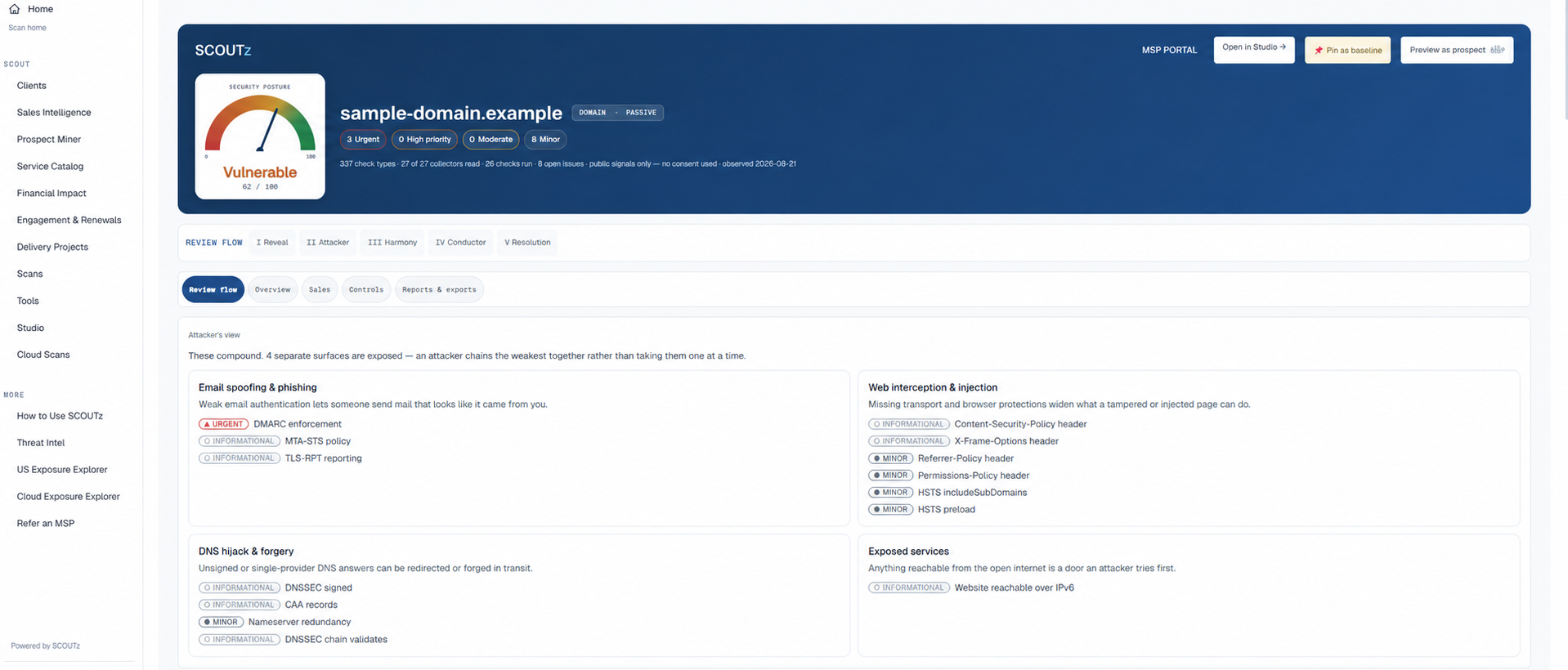
Yes. Outside-in evidence is narrow. It improves discovery by giving the MSP useful context and sharper questions while the prospect and authorized sources establish the conditions that public evidence cannot prove.
Many MSP first meetings open with a version of the same request: tell us about your environment, your users, your locations, your vendors, your security, your pain, your priorities, and your budget.
The prospect may know some of it. They may remember parts of it. They may also wonder why the expert arrived with a blank page.
Is discovery still necessary when an MSP has outside-in evidence?
Absolutely. Public evidence is narrow, and the people inside the business know conditions an external source cannot establish. The mistake is not asking questions. The mistake is asking the prospect to create all the context before the MSP contributes any.
A prepared discovery process starts with what can responsibly be known now. Company events create context. Domain evidence establishes selected external conditions. Unknowns remain visible. The seller then asks questions that clarify meaning, ownership, exceptions, and business consequence.
That changes the tone. Instead of “Do you have email security?” the conversation can become “We observed this public policy state. It does not tell us which gateway or tenant controls are active. Who owns that layer today, and how do you validate it?”
The prospect still teaches the MSP about the business. The MSP demonstrates why the questions deserve answers.
After consent, the cloud assessment can add supported configuration and metadata. It should correct the outside-in view where appropriate, not pretend the first view was complete. Each layer earns the next.
Discovery is not a questionnaire the buyer completes for the seller. It is a joint investigation in which preparation earns trust.