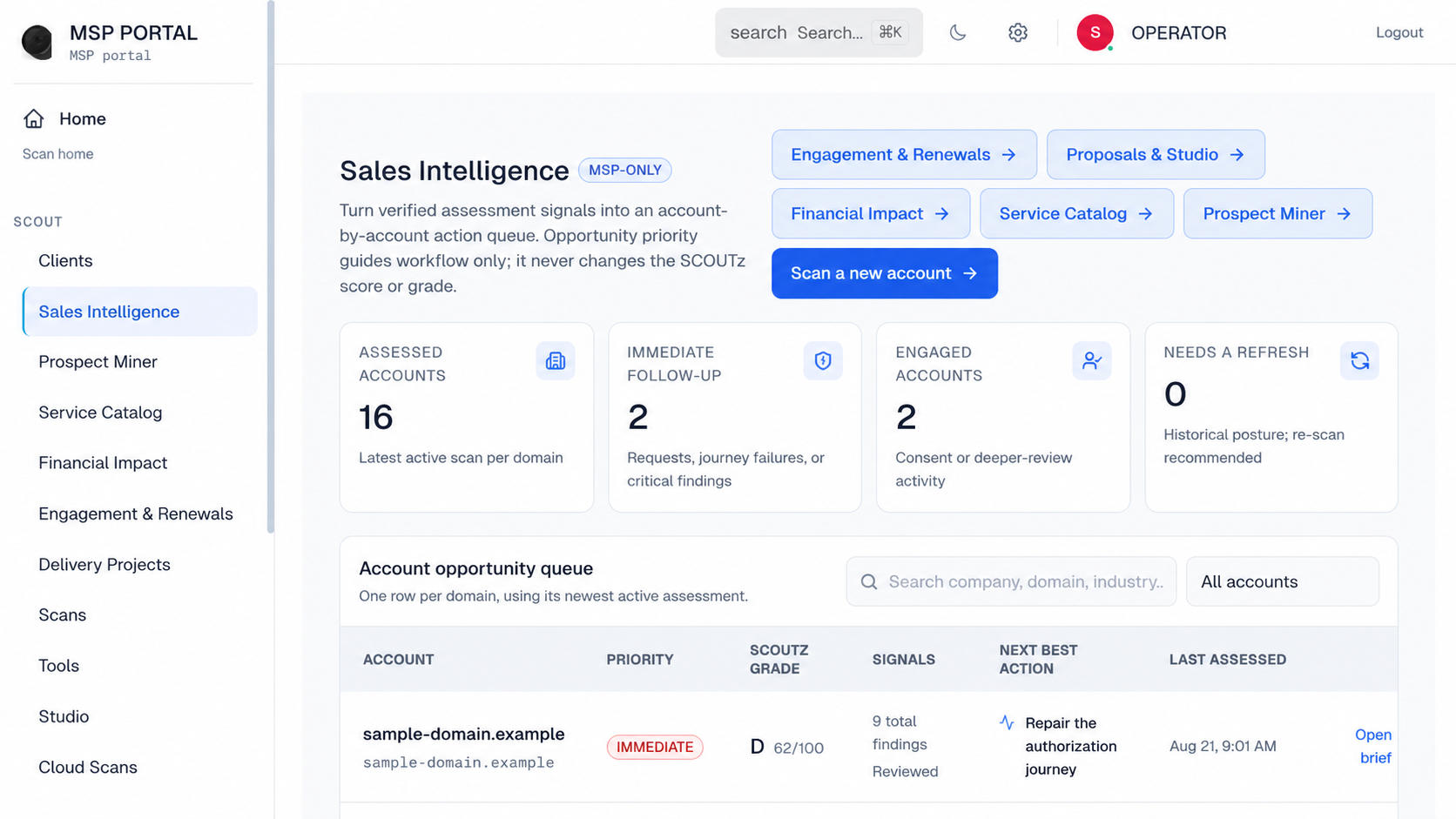
Most MSP software becomes valuable after a company is already a managed client. SCOUTz fills the earlier gap between an unknown account and an evidence-backed opportunity.
The modern MSP can do remarkable things after a client signs. We can monitor endpoints, patch operating systems, protect identities, back up data, document environments, route tickets, manage Microsoft 365, watch security events, and report on the work. The operational stack is deep because the industry spent decades making it deep.
Then look at the day before the first appointment.
The seller often has Google, LinkedIn, a company website, a lead record, a few notes, experience, and a discovery form. In other words, the person trying to win a six-figure managed-services relationship may arrive with less inspection support than the person estimating an air conditioner.
That is not an insult to the salesperson. It is a product gap. We built excellent systems for customers we already have and left the customer we do not have yet mostly to tribal knowledge.
What is missing before the contract?
The missing layer is not another CRM and it is not a public score pretending to know the inside of a company. It is a responsible way to assemble what can be known before access: company context, dated public events, public domain evidence, source confidence, explicit unknowns, and questions worth asking.
That changes the first conversation. The seller can explain why the account deserves attention, show what was observed, say what the observation does not prove, and ask permission for the next level of evidence. Preparation becomes specific without becoming invasive.
After authorization, the evidence can deepen. Customer-approved Microsoft 365 collection can replace selected assumptions with supported identity, application, consent, licensing, and managed-device context. The recommendation becomes more precise because the source became stronger.
Where should SCOUTz stop?
When a recommendation becomes operational work, the MSP already has systems designed to execute it. The PSA should own tickets, projects, time, and delivery. The RMM should manage endpoints. Microsoft administration should configure the tenant. EDR, backup, SOC, documentation, and network platforms should do the jobs they were built to do.
SCOUTz should create better inputs for those systems: a cited condition, an affected object, the boundary, the recommendation, the owner, the verification criteria, and the reason the work matters.
The thesis is simple: the MSP industry built an incredible tool stack for customers it already has. SCOUTz was built for the customer it does not have yet.
Get from unknown company to understood opportunity. Earn the deeper assessment. Hand justified work to the operational stack. Return later to verify what the observable evidence says changed.
That is enough territory for one product. Frankly, it is a lot more useful than accidentally building a mediocre RMM with a prospecting tab.